Trams, bikes, rain – sound familiar?

So the other day I went to Amsterdam for a couple of hours. Yes, it’s a long way from Australia, but I have form in this area. I once flew to Benidorm for lunch from Lancashire, but that’s another story.

This time it was a very brief stop on a flight from Melbourne to Glasgow. The Silver Fox and I had four hours to kill and while Schiphol is undoubtedly a fine airport, we thought it would be more fun to jump on a train and go and visit the canals. So we did.

On the basis that any time away from the airport counts as a visit to a country, this was my fourth time in the Netherlands. I’ve explored Amsterdam, of course, but also the other major cities, and even made it to a wedding in Wemeldinge, a small village in Zeeland, where the bride and groom had their photos taken atop a dyke.

Going back for the first time in a decade, albeit briefly, reminded me of how much I love the place. There are so many reasons.

Obviously, there’s the cycling. Getting around on two wheels is the norm for many people, and drivers respect that. The infrastructure for cyclists is great and it’s so safe no-one ever needs a helmet. People ride in their everyday clothes and when it rains, it’s not unusual to see a bicyclist carrying an open umbrella as they pedal along.
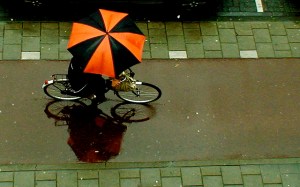
Amsterdamized

There’s the amazing public transport, that can take you from one end of the country to the other in a couple of hours, and that never lets you miss a connection because it’s just so well planned.

Then there’s the people. I am fortunate to have a couple of good Dutch friends in my life who can be relied on to tell me the truth when I need to hear it. That attitude also seems to extend beyond those who have known me for a long time. At the aforementioned wedding, a guy I had literally just been introduced to suggested that I was perhaps a little too pale to wear my chosen summer dress with bare legs. Rude? Possibly, but my legs were threatening to blind the other guests with their whiteness, and he was clearly just keen that I consider tinting my skin the same colour as his – a rather artificial hue in a shade that I can only imagine was a tribute to the Dutch royal family. I wasn’t offended.

And there’s the pragmatic approach taken to social issues that other governments spend years arguing about. Gay rights ceased to be an issue a long time ago, and while there are some critics of the Netherlands’ liberal approach to prostitution and drug use, on the whole the laws seem to work. Equality is everywhere – even the female flight attendants on KLM are able to wear natty blue trouser suits that are far more practical than the tight skirts and high heels of other airlines, should they need to do their most important job of saving your life in an emergency.

For these and so many other reasons, I love the Netherlands. So much, in fact, that I even considered – quite seriously – learning the language. I thought my Scottish accent would give me a head start on many of the guttural noises needed to sound convincing; I changed my mind after I tried leaving a message on a Dutch friend’s answerphone, asking ‘How are you?’ in Dutch, and she asked why I was speaking Japanese. It’s also not the most useful language for the world traveller – something even the Dutch would admit. They know it will never be a lingua franca and while they appreciate any efforts to speak it (even with a Japanese accent), there is no expectation on the visitor to do so. In fact, I’ve found most of the Dutch people I’ve met are embarrassed by their (few) countrymen who can’t speak excellent English.

I probably should have tried to move there for a while when I was young, but I missed my chance, if it ever existed. I had to wait until I was in my 30s to do what was the next best thing – move to Melbourne. It’s not so dissimilar: it has trams, bikes and, at least in the inner city, a liberal (with a small L) attitude. Most Australians also fulfil the plain-speaking requirement quite nicely. Umbrellas on bikes haven’t caught on yet, but given Melbourne’s climate and inherent sense of style, it’s surely just a matter of time.

Image: Amsterdamized, under a Creative Commons Attribution-NonCommercial-ShareAlike 2.0 Generic Licence (CC BY-NC-SA 2.0). If you like it, there is more about Dutch cycling on the Amsterdamize blog


Music to move to

According to research reported this week, listening to In Da Club by 50 Cent before a job interview can increase your chances of success.

When the Silver Fox was offered the interview that would eventually lead to our move to Australia, music did play a part – although there was no rapping involved.

He had to drive to a venue on the other side of town to be interviewed via video-conference. I knew he’d be nervous and wanted to calm him down. And I also wanted him to get the job.

While we hadn’t actually agreed that we would move if he was offered it, we agreed it would be nice to have the choice.

So the night before, I sneaked out to the car and put a copy of Paul Kelly‘s album Gossip in the CD player. And when the Silver Fox started the engine the following morning, this is what he heard: Kelly’s love song to Melbourne, Leaps and Bounds.

True, we were headed to Perth, not Melbourne. And the job itself was in the Western Australian suburb of Kwinana, known in polite circles as a lower socio-economic area, famed for the industrial plants along its shoreline, rather than one of the world’s most liveable cities with world-class sporting facilities as name-checked in Kelly’s song.

But the sentiment was right, and it did the trick. Two months later we were in Australia, and we did finally make it to Melbourne – without any help from 50 Cent.


The joy of the incidental visitor

Welcome MatWhen you leave one side of the world for the other, you know that you will never see some people again. It’s a harsh reality of expat life: you invite everyone to come and visit you in your new home, and everyone promises they will, but it doesn’t happen. Money, family…LIFE gets in the way.

Close family will come, if you’re lucky, but there is no guarantee. Surely it would be better for you to come here, they say. You can see everyone that way, and you’re used to the long flight, not like us. Wouldn’t you rather come back than put us up for a month? We don’t want to impose.

So while our spare room is the only room in our house that is propery finished, it’s also the least-used. We’ve only had one set of ‘proper’ family visitors in the five years since we migrated, and they’ve made it clear that they have no intention of coming back. If we want to see them again, Mohamed will have to go to the mountain.

But while our nearest and dearest expend their energy on getting us back to Blighty, we’ve discovered that many other people we know do travel to Australia, usually to visit family of their own. And what has been fantastic is that they often take the opportunity to spend a little time with us.

Our first ‘incidental visitor’ – a former work colleague of the Silver Fox – called on us just months after we moved, during a visit to family in Perth. Another making a similar trip followed soon after. And in a couple of months we will meet an old journalist friend (and former boss) of mine for dinner. It’s been 15 years since I left the paper we both worked on, and almost as long since we’ve spoken. But he’s coming out to Australia to visit others, remembered I was in Melbourne and decided to look me up. I’m looking forward to it already.

These brief get-togethers are an opportunity to share a little of our new life, catch up on some gossip and hear a familiar accent. For at least some of the visitors, I’m sure we have provided some respite from family business, and the endless cups of tea which punctuate visits to overseas relatives.

So should you wish to pop in, for an hour, a day or a week, you’ll be very welcome. But beware the risks – one of these incidental visitors is bringing her family back to Melbourne in a few weeks, to stay for good.

Outside my comfort zone

Comfort zoneSince moving to Australia I’ve pledged to accept pretty much every invitation offered, even although this has occasionally gone horribly wrong. This ‘say yes to everything’ policy means I frequently head out on my own – not every invitation is extended to the Silver Fox, and even if it is, he doesn’t always want to join in.

While this has been a fantastic way of getting to know new people and learning about my adopted home, it has aggravated a phobia I’ve had all of my life – a fear of going into a pub on my own.

If I arrange to meet someone for a night out and will be arriving alone, I will go to ridiculous lengths to make sure I don’t have to meet them inside the venue. I’ll query their transport arrangements with the hope of finding a sensible meeting point at a station or tram stop, or turn up at their house an hour early so I can travel with them. I don’t know what I’m actually scared of, but I suspect it’s a mixture of a fear of not being able to find the venue, coupled with a sense that nice girls don’t sit on their own in bars. The former is a rational reaction to a lifetime of not being entirely sure of my location or which direction I should be walking/driving/cycling in; the latter a stupid idea formed by years of watching films where the only girls sitting alone at the bar are prostitutes.

Melbourne is particularly ill-suited to the nervous solo pub-goer. So many bars are hidden away, down alleyways and up stairs, and you’re never quite sure where you’re going to end up. One I visited recently could only be accessed by a lift tucked inside a (totally unrelated) Chinese restaurant. To get to another, you have to go through an anonymous doorway, head up two flights of stairs, and pass through a different club before reaching your destination on the rooftop. It is, of course, these quirks that make Melbourne’s bar scene so famous, but if I don’t know the place, my anxiety rises with every flight of stairs conquered or floor passed in the elevator.

Things have certainly been made easier by the mobile phone. I can now harangue my soon-to-be-companions with texts, updating my progress towards the venue and confirming theirs, with the aim of magically arriving at the same time. If I’m running early and need to delay my arrival, I can pause in the street and amuse myself on Facebook for a while pretending to be checking urgent work emails. And if I – horror of horrors – actually get to the venue first, and successfully find my way in, I can perch at the bar/in a corner/outside the toilets and nonchalantly check Twitter, as if it were the most comfortable place in the world for me to be.

People I know well are used to my insecurities and make the required allowances. With new friends, however, I have little option but to take a deep breath and head into the unknown, lest they think I am anything less than the confident, hilarious and kind-spirited person I spend my days pretending to be.

This act was put to the test last night when I was invited to watch a (new) friend’s son’s band play at a jazz venue in the CBD. The Silver Fox had planned to come with me, but pulled out at the last minute, overcome by exhaustion caused by a month of early starts to watch the football and a fortnight of late nights watching the cycling. Not only would I have to turn up on my own, once I got there I would only know one of the group of eight or so attending.

But of course it was fine. I turned up first, found myself a seat at the bar and ordered a drink. My phone couldn’t get a signal inside so I had no option but to just sit there, people-watching and enjoying the music. It no doubt helped that it was a jazz bar and not a club frequented by drunken 25-year-olds, but still… When the group I was meeting turned up 10 minutes later, I told one of the women about my ‘say yes to everything’ policy, leaving out the detail of the anxiety attacks it causes. She was lovely, praising my positive attitude and congratulating me for stepping out of my comfort zone. And that’s the point. Every time I do something like this I do step out of my comfort zone, and it’s almost invariably worth it. Last night certainly was. If only my heart rate would listen to my head.

Image: Comfort Zone by redfishingboat (Mick O) is licensed under CC BY-NC 2.0

Losing a language

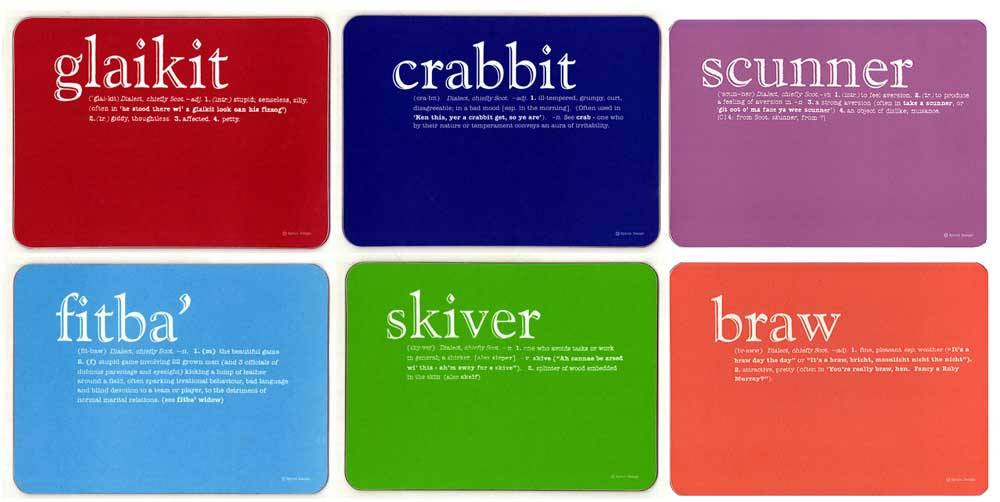
Scots dialect tablematsI read a story on the BBC website recently about people who had lost fluency in their own language. At first the idea seemed ridiculous, particularly as I work with words. Surely I could never forget what they mean, no matter how embedded in another culture I become?

But even although I have spoken English all my life – a few years at night school practising tortured Spanish aside – it did make me wonder if my travels had had an impact on the way I speak.

I grew up in Scotland, but never considered myself to have a particularly strong accent; not did I use a lot of Scots dialect. So the people in my home town might have had accents broad enough to warrant English subtitles on a film set there, but with the naivety of anyone who had never travelled far, I assumed that I’d always be understood. With a mother from the west of Scotland and a father from the east, I’d never developed the intensely localised vocabulary of either community. I was also a bit of a snob, associating true Scots dialect with the working class of which I was most definitely part, but which I was keen to escape. I remember finding a dialect dictionary in the university library and gleefully searching for the words I’d heard my mum use a million times, but which sounded strange on my own, aspiring middle class lips. Continue reading

Catfish – the Australian edition

One of my favourite shows on TV at the moment is Catfish. It’s a documentary series made for MTV about people who met online, but have never met in real life. The show brings them together, which usually involves an interstate road trip, and as you might expect, not everyone is who or what they claim to be online.

On a superficial level I love it because of the handsome and engaging host, Nev Schulman. While other women swoon over rock stars and actors, documentary makers seem to be my thing. You can keep Brad Pitt: I’ll take Louis Theroux any day. But it’s not just Nev’s perfect American teeth and luxuriant chest hair – which seems to make an appearance more often than is strictly necessary for a documentary –  that keep me tuning in. Nor is it his endless optimism and complete lack of cynicism (“Sure! So you told Vanessa that you were a male model with a Lamborghini  and a Calvin Klein contract and you’re actually an 18-year-old girl who lives with her mom in a trailer in Wisconsin. But hey, maybe you can still be friends!”).

Nev Schulman

Nev Schulman, possibly the nicest man on television

No, I watch because I cannot believe that people can build relationships as deep as they claim to have without ever having seen each other. Some talk daily by telephone, all are heavy users of Facebook chat and texting, but despite their love of technology and apparently generous data allowance, none of them have ever had a video chat on Skype. They are prepared to propose marriage, and plan the children they will have together, all on the basis of a voice and some Facebook pictures. Continue reading

Footy fever

HawksNow that I’m Australian, I have to do Australian things. And that means going to the footy.

AFL is as much a part of life in Melbourne as trams and hipster baristas. If you meet someone new, you can be pretty sure they will ask you who you barrack for (note: never support, always barrack for) early in the conversation. If you don’t have a team you’re considered a bit odd.

So I got myself a team pretty sharpish: Hawthorn FC. Contrary to popular belief, this wasn’t because they win a lot. Nor was it because I find their brown and gold strip particularly attractive (I much prefer Port Adelaide’s black and teal ensemble). No, it was a practical decision. The Silver Fox had sworn allegiance to Hawthorn more than 20 years ago when he saw them play on his first visit to Oz. While he would argue that I am not inclined to follow his advice on much else, he knows his football, so I decided it would be simplest to tell people that I, too, barrack for the Hawks. Continue reading

Welcome to Australia?

Not taken at my ceremony. Picture Glenelg Shire Council.

Not taken at my ceremony. If only I’d lived in Glenelg Shire, I’d have got a plant.

In the four years while I waited to qualify for Australian citizenship, I’d occasionally imagine what my ceremony would be like. I’d read about them – jolly events where the latest batch of immigrants celebrated their newly-earned Aussieness amongst family and friends. I’d heard tales of sausage sizzles and gifts of trees, of handshakes from Mayors and enthusiastic flag-waving.

And even although I told everyone I was really only upgrading my permanent residency to citizenship so that I could vote and choose the appropriate passport for the shortest queue at the airport, I was still a little bit excited about taking the pledge. Continue reading

What’s in a name?

As a British migrant raised on Neighbours, I didn’t anticipate many language issues in Australia. Sure, there would be Aussie slang to deal with and I would have to learn to drop the final two letters from programme, but I reckoned there would be no struggles with pronunciation. Everyone speaks English, right?

Right – except an increasing number of those English speakers have come from somewhere else, and brought with them a fantastic array of names. Prior to my move here, my only real experience of Asian names was the branch of my extended family with the surname Ng. The trouble was, no-one ever said it out loud, so I grew up having no idea how it was pronounced. In the end I learned from US alternative band They Might Be Giants. Continue reading

Becoming Australian

Australian flagIn less than a week the Silver Fox and I will become Australian citizens.

Our Aussie citizenship has been almost five years in the making. First there was the 457 visa that got us to Perth, swiftly followed by an application for permanent residency. A few months, one excruciating English test for the (native English-speaking) Silver Fox and a quick trip to Sri Lanka for activation purposes later and we had PR. Then, just like with Australian health insurance, there was a waiting period: four years before we could apply for citizenship.

Four years is plenty of time to fret about the next stage in the process – the exam.

The citizenship test has almost mythical status among ex-pats here. Rumours abound as to its content. Don Bradman’s batting average features heavily in these rumours, as does an encyclopaedic knowledge of AFL teams. In reality, the knowledge you need to pass is probably far less useful in everyday life. You are quizzed on the various Australian flags, on the rights and responsibilities of citizens and the way government works. More than one Australian friend has told me they would struggle to pass. Continue reading